





- February 11, 2026
- Career
Designing End-to-End Azure Data Engineering Architecture for Large Enterprises
In the era of big data, large enterprises rely heavily on their data platforms not only for reporting but also for deriving strategic insights, enabling real-time decision-making, and powering advanced analytics and AI initiatives. Traditional on-premise data warehouses often struggle to keep up with the scale, variety, and velocity of modern enterprise data.
As a result, cloud-native platforms such as Microsoft Azure have become the backbone for enterprise data engineering.
Designing an end-to-end Azure Data Engineering Architecture for a large organization is not simply a matter of choosing the right services. It requires thoughtful planning around data flow, transformation, governance, security, orchestration, and cost optimization.
This article provides a comprehensive guide for designing a production-ready Azure data platform that is scalable, secure, and maintainable.
1. Understanding Enterprise Data Architecture Requirements
Large enterprises generate massive volumes of structured, semi-structured, and unstructured data daily from sources such as:
ERP systems
CRM platforms
IoT devices
Application logs
Third-party SaaS platforms
This data must support:
Executive dashboards with near real-time insights
Self-service analytics
Compliance-based historical reporting
AI-powered predictive models
Key Technical Requirements
High-throughput data ingestion
Low-latency query performance
Fault tolerance
Scalability and elasticity
Data residency and compliance (GDPR, HIPAA, SOC, ISO)
Auditability and lineage tracking
Understanding both business and technical requirements is essential before designing the architecture.
2. High-Level Azure Data Engineering Architecture
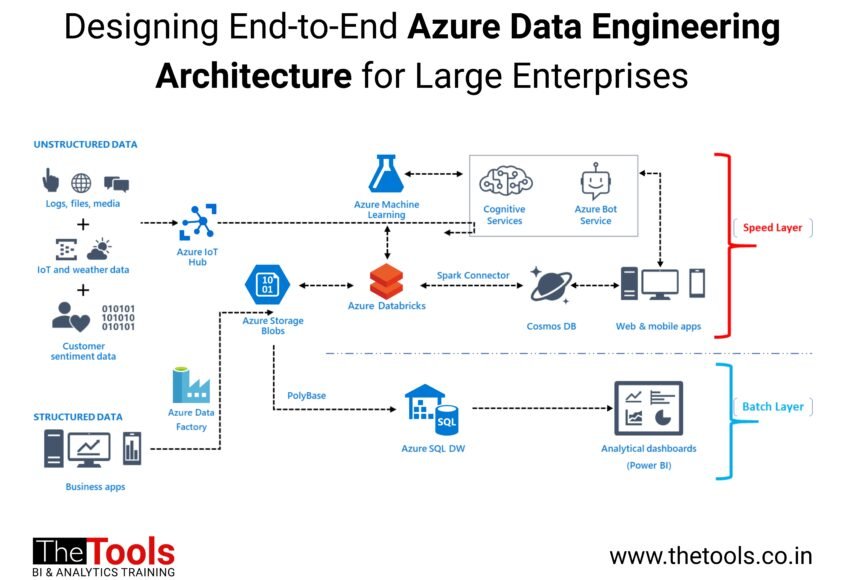
A well-designed Azure data architecture follows a layered approach:
Data Sources Layer
Data Ingestion Layer
Data Storage Layer (Data Lake)
Data Processing & Transformation Layer
Serving & Analytics Layer
Orchestration & Monitoring
Security & Governance
DevOps & Cost Optimization
This layered architecture ensures scalability, separation of concerns, and maintainability.
3. Data Sources Layer
Enterprise data originates from:
On-premise databases (SQL Server, Oracle, SAP, Teradata)
Cloud databases (Azure SQL Database, Cosmos DB)
SaaS applications (Salesforce, Dynamics 365, ServiceNow)
Files (CSV, Excel, JSON, XML, Parquet)
Streaming sources (IoT, telemetry, logs)
Secure Connectivity
Azure ExpressRoute for high-bandwidth private connectivity
Self-Hosted Integration Runtime for private network access
Change Data Capture (CDC) for incremental loading
Retry mechanisms and throttling for resilient ingestion
4. Data Ingestion Layer
Azure Data Factory (ADF) acts as the backbone of enterprise ingestion.
Batch & Incremental Processing
100+ native connectors
Parameterized pipelines
Metadata-driven frameworks
Separation of ingestion and transformation pipelines
Real-Time Ingestion
Azure Event Hubs (high-throughput streaming)
Azure IoT Hub (device telemetry ingestion)
Azure Stream Analytics (real-time processing)
This hybrid ingestion model supports both batch and streaming use cases.
5. Data Storage Layer – Azure Data Lake Storage Gen2
Azure Data Lake Gen2 serves as the centralized storage foundation.
Key Benefits
Scalable storage
Cost efficiency
Integration with Databricks, Synapse, Power BI
Fine-grained access control
Azure AD integration
Medallion Architecture (Bronze–Silver–Gold)
Bronze Layer
Raw, immutable data
Used for auditing and reprocessing
Silver Layer
Cleansed and standardized data
Schema validation applied
Gold Layer
Business-ready datasets
Optimized for reporting and ML
This structure ensures data quality and maintainability.
6. Data Processing & Transformation Layer
Azure Databricks
Distributed Spark-based processing
Batch and streaming workloads
Delta Lake integration (ACID transactions, schema enforcement, time travel)
Azure Synapse Analytics
Dedicated SQL pools (predictable workloads)
Serverless SQL pools (ad-hoc queries)
Massively parallel query processing
Enterprises often combine Databricks (transformation) and Synapse (analytics).
7. Analytics & Consumption Layer
Data consumption tools include:
Power BI
DirectQuery and Import modes
Incremental refresh
Row-Level Security (RLS)
Object-Level Security (OLS)
Advanced Analytics
Azure Machine Learning
Databricks MLflow
Synapse Spark Pools
This layer enables predictive modeling, forecasting, and AI-driven insights.
8. Orchestration & Workflow Management
Azure Data Factory orchestrates:
Pipeline dependencies
Scheduling
Retry mechanisms
Monitoring tools include:
Azure Monitor
Log Analytics
Automated alerts
This ensures reliability and SLA adherence.
9. Security Architecture
Enterprise-grade security includes:
Azure Active Directory (Identity Management)
Managed Identities
Role-Based Access Control (RBAC)
Encryption at rest and in transit
Customer-managed keys
Virtual Networks & Private Endpoints
Firewall rules
Security is enforced at every layer.
10. Data Governance & Compliance
Microsoft Purview provides:
Data cataloging
Lineage tracking
Sensitive data classification
Audit logging
Data quality monitoring
Strong governance builds trust and ensures regulatory compliance.
11. DevOps & CI/CD for Data Engineering
Best practices include:
Git-based source control
CI/CD pipelines
Automated deployment across environments
Parameterized configurations
Versioning of notebooks and pipelines
This improves reliability and agility.
12. Cost Optimization Strategies
To manage cloud costs:
Lifecycle policies (Hot → Cool → Archive tiers)
Auto-scaling clusters
Job scheduling
Azure Cost Management & budget alerts
Balancing performance and cost is critical in enterprise environments.
13. High Availability & Disaster Recovery
Enterprise resilience requires:
Multi-region deployments
Geo-redundant storage
Automated failover
Defined RPO & RTO
Automated recovery workflows
This ensures business continuity.
Conclusion
Designing an end-to-end Azure Data Engineering architecture for large enterprises requires strategic planning, technical expertise, and continuous optimization.
By leveraging Azure services such as:
Azure Data Factory
Azure Databricks
Azure Synapse Analytics
Azure Data Lake Gen2
Power BI
Microsoft Purview
Enterprises can build a unified, secure, and scalable data platform that supports reporting, analytics, AI, and long-term innovation.
A well-architected Azure data platform transforms raw data into actionable insights and empowers organizations to thrive in a data-driven world.
