





- February 16, 2026
- Career
Designing Medallion Architecture (Bronze–Silver–Gold) in Azure Databricks for Enterprise Data Lakes
The exponential growth of data volumes, coupled with increasing diversity in data sources, has fundamentally altered the way enterprises design analytical platforms. Traditional data warehousing approaches, which rely on rigid schemas and centralized transformation logic, have proven insufficient for handling the scale, velocity, and variability of modern data.
In response, organizations have adopted data lake architectures that prioritize scalability and flexibility. However, without a well-defined organizational model, data lakes often devolve into unstructured repositories that are difficult to govern and unreliable for analytics.
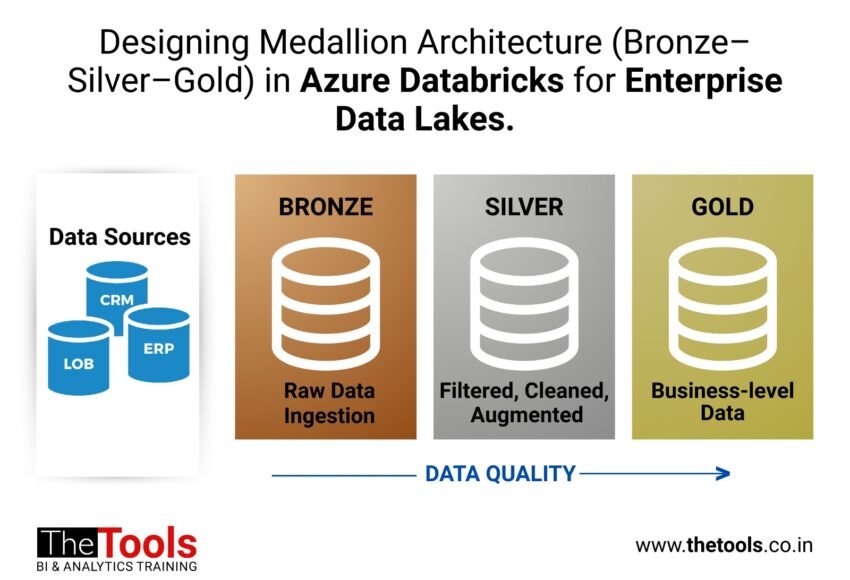
Medallion Architecture has emerged as a systematic design paradigm for addressing these limitations. It introduces a layered structure—commonly referred to as Bronze, Silver, and Gold—that represents successive stages of data refinement. Each layer serves a distinct functional role within the data lifecycle, enabling controlled data evolution from raw ingestion to business-ready consumption.
Within the Azure Databricks ecosystem, Medallion Architecture aligns closely with the principles of the lakehouse model. By leveraging Delta Lake, distributed compute, and integrated governance capabilities, enterprises can construct data platforms that balance flexibility with reliability while supporting a wide range of analytical and operational workloads.
1. Enterprise Data Lake Challenges Addressed by Medallion Architecture
Despite their theoretical advantages, enterprise data lakes frequently encounter practical challenges related to data quality, performance, and governance.
Raw data ingested from operational systems often contains inconsistencies, missing values, duplicates, and schema variations. When such data is exposed directly to analytical users, it undermines trust in reported metrics and increases the operational burden on data engineering teams.
Performance degradation is another significant concern. Analytical queries executed directly on raw or poorly structured datasets tend to require excessive computational resources, resulting in higher costs and reduced responsiveness.
Furthermore, as data lakes grow to support multiple consumers—such as business intelligence teams, data scientists, and downstream applications—the absence of clear data refinement stages leads to tightly coupled pipelines and brittle dependencies.
Medallion Architecture mitigates these issues by enforcing a clear separation of responsibilities across layers. Each layer is optimized for a specific purpose, thereby reducing complexity, improving maintainability, and enabling independent evolution of ingestion, transformation, and consumption processes.
2. Architectural Foundations in Azure Databricks
The implementation of Medallion Architecture in Azure Databricks relies on a combination of scalable storage, reliable data management, and centralized governance.
Azure Data Lake Storage Gen2 serves as the underlying storage layer, providing high availability and cost-efficient scalability for large datasets.
Delta Lake extends this storage foundation by introducing transactional guarantees, schema enforcement, and versioned data access. These features enable safe concurrent writes, consistent reads, and reproducibility of analytical results.
Azure Databricks provides the computational layer that orchestrates data movement and transformation, offering both batch and streaming processing capabilities within a unified platform.
Governance is addressed through Unity Catalog, which centralizes metadata management and enforces fine-grained access controls. This ensures that data security and compliance requirements are consistently applied across all stages of the Medallion Architecture.
3. Bronze Layer: Raw Data Ingestion and Preservation
The Bronze layer represents the initial point of data entry into the enterprise data lake. Its primary function is to capture and persist data in its original form, thereby preserving the full fidelity of source system outputs.
This layer serves as a historical record that supports auditing, troubleshooting, and data reprocessing. Data ingested into the Bronze layer may originate from transactional databases, event streams, log files, and external services.
Given this diversity, the Bronze layer applies minimal transformation logic. Instead, it emphasizes durability, traceability, and scalability.
In Azure Databricks, ingestion pipelines commonly utilize incremental processing mechanisms such as Auto Loader or Structured Streaming. Supplementary metadata, such as ingestion timestamps and source identifiers, is typically appended to support downstream lineage analysis and operational monitoring.
4. Silver Layer: Data Cleansing, Standardization, and Integration
The Silver layer represents the transition from raw data capture to analytically reliable datasets. At this stage, data undergoes validation, cleansing, and standardization to enhance consistency and usability.
Transformations commonly include:
Deduplication
Normalization of data types
Application of domain-specific business rules
Integration of multiple data sources
Change Data Capture (CDC)
Slowly Changing Dimensions (SCD)
Delta Lake supports these transformations through merge operations, transactional updates, and versioned data access.
As a result, the Silver layer functions as a trusted, reusable foundation for both analytical and operational use cases.
5. Gold Layer: Business-Oriented Data Consumption
The Gold layer is designed to meet the specific requirements of business users and analytical applications. Unlike the generalized Silver layer, Gold datasets are tailored to particular consumption patterns such as reporting, dashboarding, or advanced analytics.
These datasets typically incorporate:
Aggregations
Calculated metrics
Denormalized structures
Dimensional modeling techniques
Performance optimization is a primary consideration, as Gold datasets are frequently accessed by interactive users.
Azure Databricks supports these needs through optimized execution engines, caching mechanisms, and query acceleration features.
6. Governance, Security, and Compliance
Effective governance is integral to the success of Medallion Architecture in enterprise environments.
Unity Catalog provides centralized visibility into data lineage and usage while enforcing access policies at granular levels. Sensitive data elements can be protected through column-level security and masking.
Auditability and traceability are enhanced through integrated logging and metadata management.
By embedding governance mechanisms directly into the architecture, enterprises can balance data accessibility with control.
7. Operationalization and Observability
The reliability of Medallion Architecture depends on effective orchestration and monitoring of data pipelines.
Azure Databricks workflow orchestration tools manage dependencies between ingestion, transformation, and consumption processes.
Observability mechanisms—including logging, metrics, and alerting—provide insight into pipeline performance and data quality, enabling proactive issue resolution.
8. Future Directions and Architectural Evolution
As enterprise data strategies evolve, Medallion Architecture remains a flexible foundation capable of supporting emerging paradigms such as:
Data Mesh
Real-Time Analytics
Machine Learning Feature Stores
The continuous evolution of Azure Databricks and the broader Azure ecosystem further strengthens the applicability of this architecture.
Conclusion
Medallion Architecture provides a structured and principled approach to designing enterprise data lakes that are both scalable and trustworthy.
When implemented within Azure Databricks, it enables organizations to manage data as a strategic asset while maintaining governance and operational efficiency.
By clearly separating raw data ingestion, data refinement, and business consumption, enterprises can reduce complexity, enhance data quality, and establish a resilient foundation for data-driven decision-making.
